
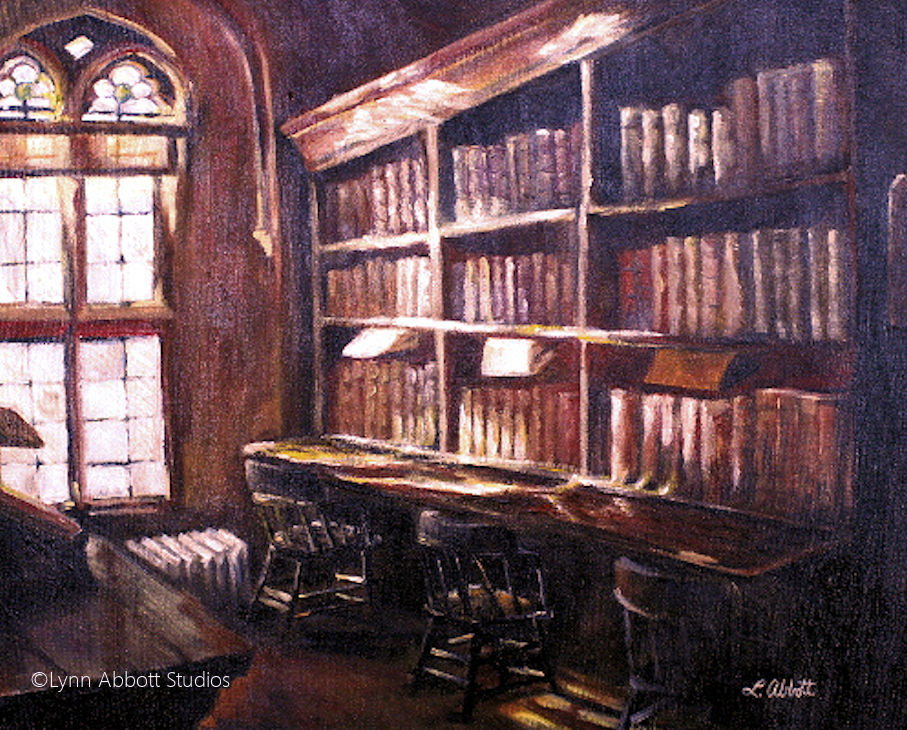
© 2015 Lynn Abbott
It’s a much quoted verse at my house these days…
“Of making many books there is no end, and much study wearies the body…” (Ecclesiastes 12:12b).
My son, a university student, just laughs. You see, his life’s ambition has always been to become a professional student. He reads constantly.
Yup, he’s smarter than his mama… in more ways than one. But I’m happy to say that he possesses more than book learning. He’s got a good head. I should take a page from his playbook, I think.
When he was just 4, he came home from Sunday School full of thoughts about the story of Solomon. And when bedtime prayers rolled around, he asked if he could pray for wisdom as Solomon did.
To be honest, I was quite taken aback. He was just four, after all. However, I agreed that it was a wonderful idea. That evening, we knelt together and with childlike faith, he prayed.
I can testify that God answered that four-year-old’s prayers.
When I need good sound advice, my 22-year-old provides tremendous insight into people and most decision-making. And that’s a whole lot more than I can say of myself.
He’s smarter than his mama… in more ways than one.
Decision-making is not my strong suit. It doesn’t matter whether a choice is critical or seemingly insignificant, I agonize over it just the same.
Indeed, it’s a standing joke at my house that I once required two years to determine whether or not to purchase a particular set of mixing bowls.
Uh, huh. Indecisive. I’ve got that wired.
Had I been in Peter’s position, I would have hesitantly climbed in and out of the boat several times before ever trying to walk on water.
Perhaps, I would have evaluated weather information, at once considering wind direction and barometric pressure. I may even have tried to estimate the distance between myself and the Savior.
I certainly would have deliberated the risk versus reward of such a choice.
Impulsive, I am not.
I am cautious like Gideon rather than bold like Peter. I dissect every decision, weighing all its parts. At times, the noisy wind and waves seem to drown out my Savior’s voice and I lose confidence… I fear the task is too great.
The world’s naysayers scream loud in the storm, and looking desperately around me, I lose faith.
When I listen to the wind, I become the epitome of James 1:6. I have asked for wisdom but doubts consume me. I waver. I become like the surf of the sea, driven and tossed by the wind.
With good humor, my son smiles when I begin dissecting. You see, while he may deliberate thoughtfully, he makes decisions with confidence. Hooray for Sunday School, Solomon and childlike faith!
At times, the noisy wind and waves seem to drown out my Savior’s voice and I lose confidence…
When I recall Solomon’s story, I best remember Scripture’s description of the early years of his reign. Again and again, Solomon distinguished himself with wise judgment.
In fact, upon assuming the throne, Solomon had prayed, “…give Thy servant an understanding heart to judge Thy people to discern between good and evil. For who is able to judge this great people of Thine?”
Truly an example to follow.
And yet, if I finish reading Solomon’s history, I find that even the author of Proverbs 3:5, 6 succumbed to doubt. And his resulting choices led him down destructive paths. Late in life, Solomon expressed tremendous regret.
That’s what we get in the book of Ecclesiastes. His hand-wringing refrain “Vanity of vanities! All is vanity” reverberates throughout his book.
Solomon had wandered. The wise king and author of Proverbs had lost his compass. Although he began his reign by fixing his confidence and trust in God, the temptation to follow human counsel eventually lured him off track.
The initial introduction of doubt, however, didn’t seem particularly significant. No alarm bells warned Solomon. In fact, the detour appeared wise by worldly standards.
Conventional wisdom often appears logical. There’s usually a bit of truth in it.
After all, people can’t walk on water. No one would argue with that.
However, with Abba, it’s never about what we can do. Instead, it’s about what He plans to do through and for us.
But Solomon looked around at the powerful nations on his borders and doubted God’s promised protection. Similar in this respect to Peter, Solomon listened to the booming wind and crashing waves.
He turned to the conventional, political wisdom of his day. The kings of neighboring nations had a simple strategy for establishing political stability.
They married for political purpose, establishing alliances and treaties through the selection of royal brides from rival nations.
Solomon evidently thought it a sensible custom and practice because Scripture tells us that he had many wives.
Unfortunately, while Solomon may have intended to establish long-term peace, he certainly chose the wrong means to secure it.
After all, God had expressly told his people that they were not to marry from the nations surrounding them. Yet, Israel’s king married from those very nations.
Conventional wisdom often appears logical. There’s usually a bit of truth in it.
And just as God had predicted, such alliances led Solomon away from God.
Solomon had wealth, power, influence and fame. But his heart was divided. He had built a kingdom on the world’s sand, and his house began to crumble.
I’ve been there. I’ve asked to walk on water, and then, become distracted by the voices in the wind.
I’ve listened to worldly wisdom, and feared God’s path. As a result, I’ve been tossed by wind and waves.
James tells me that if I lack wisdom, all I can ask God for it just as Solomon did.
However, like Solomon, I can’t expect to acquire wisdom if, when I receive God’s word, I doubt and follow my own way instead. As James says, when I respond in this way, I become double-minded.
However, all is not lost.
Peter cried out, “Lord, save me!”
And Solomon’s history gives us a glimmer of God’s grace.
Despite Solomon’s ungodly alliances, God extended peace for Solomon’s lifetime. God loved the man who once knelt in dependent, childlike faith.
And Solomon, full of regret, penned these words, “…still I know that it will be well for those who fear God, who fear Him openly,” and “Remember also your Creator in the days of your youth,” (Ecclesiastes 8:12b; 12:1).
Remember.
That’s right. When the voices in the wind cry out that I am not worthy, that I have made the wrong decision, that God’s way is foolish, that I will surely sink, I must remember my Creator.
After all, His Word serves as the ultimate litmus test. It matters not what others say (Romans 8:31). The world’s wisdom should be evaluated, approved or disapproved in light of God’s truth, (2 Timothy 3:16-17).
Solomon’s history gives us a glimmer of God’s grace.
Yes, Abba answers my doubts and fears. His guidance eliminates the need for second guessing.
The Good Shepherd calls us to exceptional living, (Psalm 23:1-3). He has invited us to ask for His direction in all our ways.
Sure, at times, His wisdom appears outrageous to the world. And the wind blusters.
But our Sovereign-Shepherd is infinitely able. He walks on water in the midst of the stormy gale.
He hears our cries. He promises to give wisdom generously and without reproach (James 1:5). By His Spirit, we are able to differentiate powerful truth from destructive lies, (Psalm 119:105).
And Solid Rock outlasts sand. God’s Word trumps worldly philosophies.
Despite his wandering, Solomon did get it right in the end. Indeed, when we lack wisdom, we need only turn from the wind and waves…
And remember our Creator.
“Do not let this Book of the Law depart from your mouth; meditate on it day and night, so that you may be careful to do everything written in it. Then you will be prosperous and successful,” ~ Joshua 1:8
 Through Ink & Image